MiniMax H3 LoRA Guide: Fine-Tuning Status, Uses, and Alternatives
Explore the MiniMax H3 LoRA landscape, what training support requires, how to evaluate adapters, and practical alternatives for consistent characters and styles.
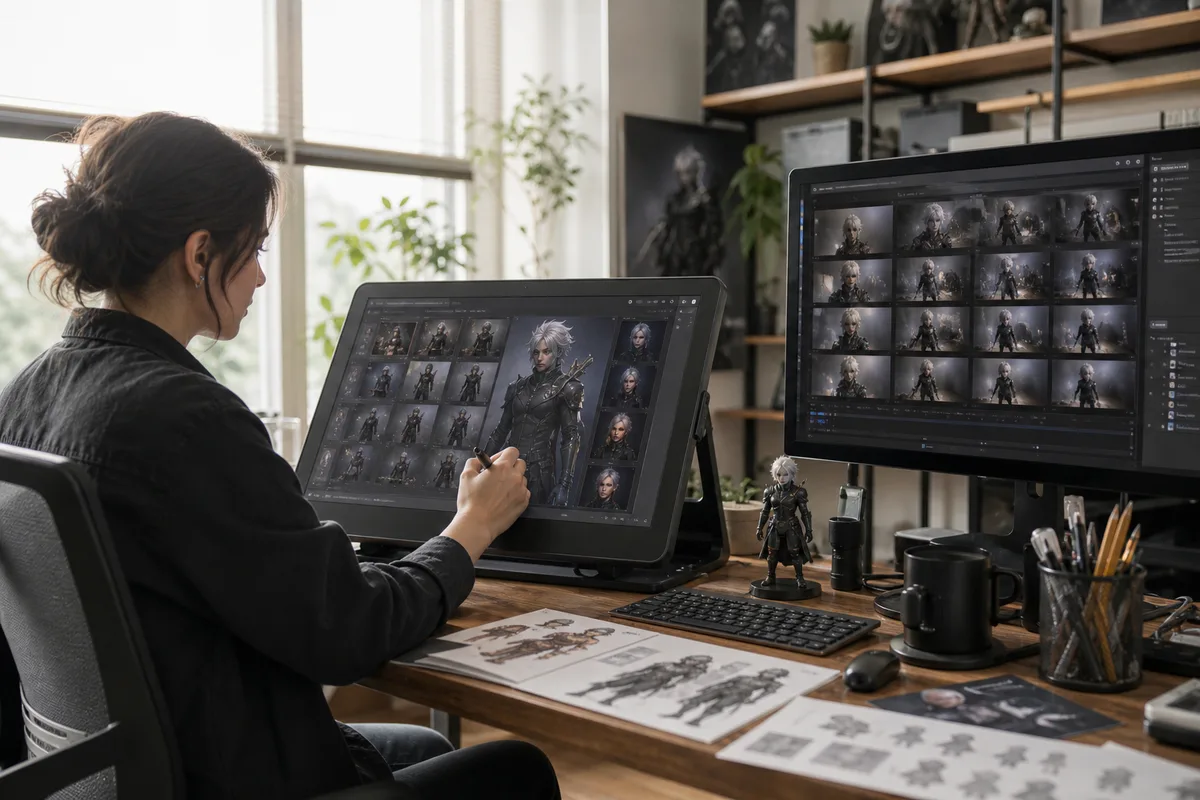
A MiniMax H3 LoRA is an appealing idea: train a lightweight adapter for a character, product, visual language, or motion style instead of fine-tuning an entire video model. The difficulty is that “the base weights are available” and “a stable LoRA training ecosystem exists” are not the same statement. Training support requires architecture-aware code, clearly selected target modules, manageable memory use, validated datasets, and an inference loader that applies the adapter correctly.
This article explains what to verify before investing in H3 LoRA training and presents alternatives that use H3's reference capabilities today. It does not claim official LoRA support unless such support is documented by MiniMax in the current model repository.
What a LoRA changes
Low-Rank Adaptation, usually called LoRA, adds small trainable matrices to selected layers while leaving the original weights fixed. The resulting adapter is much smaller than a full checkpoint. In image ecosystems, LoRAs are commonly used for identities, products, costumes, concepts, and styles.
Video is harder. A useful adapter must influence appearance without destroying motion, temporal consistency, camera response, instruction following, or audio-video relationships. Training images alone may teach a visual concept but provide no evidence about how it should move. Training clips introduce questions about frame rate, shot boundaries, captions, audio, licensing, and temporal sampling.
Is MiniMax H3 LoRA officially supported?
Check the official MiniMax H3 Hugging Face repository for training scripts, supported target modules, memory guidance, and adapter-loading examples. If those items are absent, a community script should be described as experimental rather than official.
ComfyUI supports LoRA concepts across many model families, but a generic LoRA loader does not automatically support H3. The adapter architecture, tensor names, dimensions, and injection points must match. A green node and a .safetensors file are not proof that the adapter is modifying the intended H3 layers.
The ecosystem is changing quickly after release. Use dated language in tutorials and verify recent commits. Avoid pages that promise “one-click H3 LoRA” without linking to code, training settings, base revision, and sample comparisons.
Good reasons to train an adapter
An H3 LoRA could be valuable when a production repeatedly needs the same stylized world, branded product, fictional character, wardrobe language, material response, or camera grammar. It may also help a studio encode a proprietary visual domain that is difficult to specify through text alone.
It is less appropriate when the goal can be reached with one or two reference images, when the subject changes every project, or when the required behavior is precise shot choreography. H3's multimodal reference mode is designed to accept images, videos, and audio as context. A reference image can establish identity or design, while a reference video can communicate motion and camera rhythm without training.
Dataset design matters more than the adapter file
A character dataset should cover relevant angles, expressions, distances, lighting, clothing variations, and backgrounds without teaching unwanted correlations. A product dataset should preserve shape, materials, proportions, logos, and packaging from multiple viewpoints. A style dataset needs visual coherence without copying a living artist or using unlicensed work.
For video training, curate clips with stable frame rates and clean temporal structure. Remove duplicate frames, transitions, watermarks, unrelated subtitles, and compression artifacts. Decide whether audio is part of the training objective or should be excluded. Captions should describe what changes through time: subject motion, camera movement, lighting changes, dialogue, and sound—not just a static frame.
Use only material you are authorized to train on. Consent and publicity rights matter for real people. Product trademarks and copyrighted characters can create additional commercial risk. Keep a dataset manifest recording source, license, permission, and intended use.
Training hardware and memory
LoRA is lighter than full fine-tuning, but video training remains expensive. It stores activations across spatial and temporal dimensions and may involve multiple encoders. Gradient checkpointing, mixed precision, low-rank settings, frame sampling, and optimizer choice all affect memory.
Do not infer training requirements from inference benchmarks. A GPU that generates a short quantized clip may be unable to train even a small adapter at the same resolution. CPU offloading can make an experiment start while reducing training speed enough to be impractical. Before renting hardware, run a short documented smoke test and estimate total steps, checkpoint size, validation frequency, and storage.
How to evaluate an H3 LoRA
Evaluation should test more than resemblance. Use prompts that vary camera distance, lighting, background, action, wardrobe, and duration. Compare the base model and several adapter strengths with fixed seeds. Look for overfitting, frozen expressions, repeated backgrounds, color contamination, identity drift, motion degradation, and loss of prompt control.
For a product adapter, inspect geometry and text in motion. For a style adapter, check that different subjects remain distinct. For a character, test profiles, occlusion, speech, hands, and interaction with another person. A strong close-up does not prove the adapter works in a multi-shot sequence.
Retain validation prompts that were not used during training. If every showcase uses training-like compositions, the adapter may be memorizing rather than generalizing.
Adapter strength and prompt interaction
More strength is not always better. High strength can force identity or style while reducing motion and prompt adherence. Low strength may preserve the base model but fail to establish the concept. Test a small range systematically and record the loader version and base model revision.
Prompt the concept consistently using the trigger convention documented by the trainer. Avoid stacking several untested adapters at once. Their effects may conflict, and memory use can increase. Establish a baseline for each adapter before combining character, style, and motion customization.
Better alternatives available now
For many users, H3's reference inputs solve the actual problem faster:
- Use reference images for identity, wardrobe, product design, or visual style.
- Use a first frame when the opening composition must be exact.
- Use first and last frames when both endpoints matter.
- Use reference video for motion, performance, or camera rhythm.
- Use reference audio for voice, music, timing, or atmosphere where supported.
- Write explicit preservation instructions in the prompt.
This approach requires no training dataset and can be changed per generation. Our multimodal reference documentation explains how these roles work in the current product.
How to assess community downloads
Only use an adapter with a stated base model revision, training method, dataset description, license, recommended loader, trigger words, and example settings. Verify file hashes and repository history. An adapter file is not automatically safe or legally usable because it uses safetensors; the depicted subject and training data may still be unauthorized.
Avoid downloads claiming to add prohibited identities or remove safety behavior. They create obvious platform, legal, and payment risk. Commercial teams should maintain an approved adapter registry rather than allowing arbitrary uploads.
Recommendation for creators
If you need a consistent subject today, test multimodal references first. They reflect H3's central product design and are available through the official V2 API. If a repeated production need remains unsolved, then evaluate an H3-specific LoRA trainer with documented architecture support and a small licensed dataset.
Do not buy hardware or publish a commercial training service based only on a social-media claim. Recheck official releases, reproduce a small experiment, and validate output across motion—not just still frames.
You can begin with reference-based creation in the MiniMax H3 playground and learn prompt structure in the H3 prompt guide.
Sources and related reading
- Official MiniMax H3 repository
- MiniMax H3 V2 multimodal API
- Official ComfyUI repository
- MiniMax H3 Hugging Face guide
This article is independent and will be updated as verified H3 training support matures.
Categories
More Posts
MiniMax H3 ComfyUI Guide: Setup and Local Workflow
Learn how a MiniMax H3 ComfyUI workflow is structured, what local setup requires, and when an online H3 generator is the more practical choice.

MiniMax H3 GGUF Guide: Quantization, Compatibility, and Safety
Learn what a MiniMax H3 GGUF conversion can and cannot do, how quantization affects VRAM and quality, and how to verify community files safely.

MiniMax H3 on Hugging Face: Files, Model Card, License, and Setup
A practical guide to the official MiniMax H3 Hugging Face page, including model files, revisions, licensing, downloads, and local workflow checks.
Newsletter
Join the community
Subscribe to our newsletter for the latest news and updates